

The global market finds itself navigating an exceptionally turbulent landscape. From severe geopolitical shocks disruptive to global energy lines and supply chains to widespread economic uncertainty, enterprises worldwide are dealing with intense bottom-line pressures. Operating margins are being squeezed from multiple angles, leaving corporate leadership with a mandate to optimize overhead without sacrificing daily operational integrity.
For many organizations, the search for cost efficiency begins with evaluating redundant non-core functions. Chief among these is payroll processing—a highly specialized, time-sensitive administrative chore that consumes significant capital when managed internally.
In the search for operational survival and growth, Payroll Outsourcing Philippines has transitioned from an optional cost-cutting strategy to an essential structural upgrade. When combined with holistic HR Outsourcing and Back-office Outsourcing, delegating your payroll operations to specialized professionals in the Philippines provides a unique mix of financial relief, technological edge, and absolute compliance security.
The Macroeconomic Context: Squeezing the In-House Bottom Line
The domestic and international corporate landscapes are feeling the weight of persistent inflation. Central banks have implemented stringent monetary policies to combat rising costs, causing capital to tighten. For businesses operating within or expanding into the Philippines, running a localized, internal payroll team is becoming remarkably cost-prohibitive.
When capital is constrained and hiring freezes limit your capacity to expand internal departments, the hidden costs of maintaining an in-house payroll infrastructure quickly become apparent. In-house processing is reactive, prone to single-point-of-failure risks (such as a payroll manager resigning right before a disbursement cycle), and demands constant capital allocation for software licenses, localized security systems, and mandatory continuous training.
In-House vs. Outsourced Payroll: A Real-World Financial Analysis
To see the financial reality clearly, look at the mathematics behind running a mid-sized operation in the Philippines. Consider an enterprise maintaining a workforce of approximately 300 employees.
The True Cost of an In-House Team
To run an internal department capable of managing 300 individuals smoothly, an enterprise must fund:
- Multiple dedicated payroll and HR specialists.
- Enterprise-tier payroll software and attendance tracking subscriptions.
- IT infrastructure capable of securing personal sensitive data.
- Ongoing compliance training to keep staff aligned with rapid regulatory adjustments.
Cumulatively, maintaining this fully loaded internal department demands an annual budget ranging between ₱7.5 million and ₱10.5 million.
The Outsourced Alternative
In contrast, contracting the exact same volume of work to an experienced external provider typically requires an investment of only ₱2.5 million to ₱4.5 million annually. This shift yields a potential savings of 60% to 70% on direct operational costs.
| Cost Component | In-House Payroll Team (300 Staff) | Outsourced Payroll Model |
| Personnel Salaries & Benefits | High (Multiple full-time positions + backfills) | None (Covered by vendor service fees) |
| Software, Infrastructure & IT | Expensive enterprise licensing & server upkeep | Built-in to the per-employee-per-month rate |
| Compliance & Legal Auditing | Internal liability if mistakes occur | Guaranteed by the provider’s legal team |
| Average Annual Budget | ₱7.5M – ₱10.5M | ₱2.5M – ₱4.5M |
| Strategic Outcome | High risk, fixed operational drain | 60%–70% cost reduction |
By moving from a high-overhead internal structure to a variable, per-employee pricing model, companies can convert rigid fixed expenses into agile, scalable variable costs.
Navigating the Regulatory Tightrope: The Compliance Shield
Financial savings are a strong motivator, but the most dangerous aspect of internal payroll management is compliance risk. The Philippine labor environment is famously complex, dictated by more than 100 distinct labor and compliance rules monitored by the Department of Labor and Employment (DOLE).
The Trap of Multi-Layered Calculations
A standard Philippine payroll run does not simply involve basic salary computation. It requires precise calculation across a wide array of pay categories:
- Mandated 13th-month pay accruals.
- Complex night shift differentials (minimum 10% legal mandate).
- Overtime premiums (25% basic hourly rate adjustment).
- Regional minimum wage variances and multi-tiered holiday pay.
Constantly Evolving Tax Legislation
The Bureau of Internal Revenue (BIR) regularly updates tax tables, exemptions, and corporate remittance structures. For instance, recent regulatory implementations under Revenue Regulations No. 29-2025 significantly shifted the tax-free limits for employee de minimis benefits, expanding categories like uniform allowances (₱8,000/annually), rice subsidies (₱2,500/monthly), and medical cash allowances.
An internal team that fails to adapt to these shifts exposes your enterprise to major BIR penalties, delayed filings on BIR Form 1601C, or incorrect year-end generation of employee Form 2316 certificates. Professional payroll providers operate with specialized localized software built specifically to incorporate these shifting calculations instantly, shielding your business from compliance audits and legal friction.
The Strategic Alignment of Payroll, HR, and Back-Office Outsourcing
Payroll does not exist in an organizational silo. It is intimately bound to timekeeping, employee records, benefits administration, and bookkeeping. This interconnectedness is why forward-thinking enterprises view payroll outsourcing as the foundational step toward broader Back-office Outsourcing and HR Outsourcing.
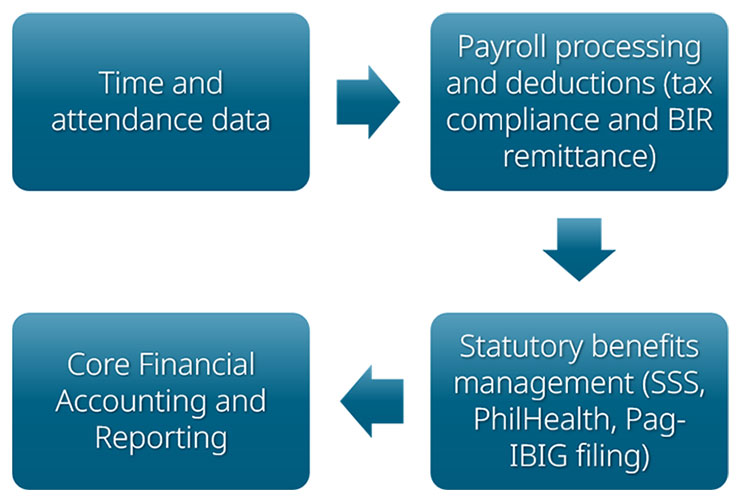
When you integrate payroll processing with an end-to-end back-office strategy, you create a seamless operational pipeline:
- HR Outsourcing Continuity: The provider manages the underlying time and attendance data, tracking leave balances, absences, and shifts directly. This tracking feeds smoothly into the payroll computation engine, eliminating manual double-entry errors.
- Back-Office Financial Unity: The outputs generated from regular payroll cycles flow directly into your core financial ledgers. Your general journal entries, cash flow statements, and operating cost records remain accurate and audit-ready without manual intervention.
- Unified Government Remittances: The same team handles the actual, direct distribution and remittance of monthly mandated government benefits including the Social Security System (SSS), PhilHealth, and Pag-IBIG (HDMF).
Ironclad Data Security under the Data Privacy Act of 2012
Payroll data is among the most highly targeted, sensitive information that organizations handle. It contains bank routing information, individual salary grades, home addresses, tax identification numbers, and national government identifiers.
The corporate sector has seen an increase in digital data breaches. Unsecured internal spreadsheets shared across unprotected cloud networks often lead to devastating information leaks, compromising corporate trust and causing significant regulatory violations.
Under the Data Privacy Act of 2012 (Republic Act No. 10173), any entity processing employee data must maintain strict technical, physical, and administrative safeguards. The National Privacy Commission (NPC) enforces heavy penalties and strict legal accountabilities for organizations that expose data through inadequate data protection infrastructure.
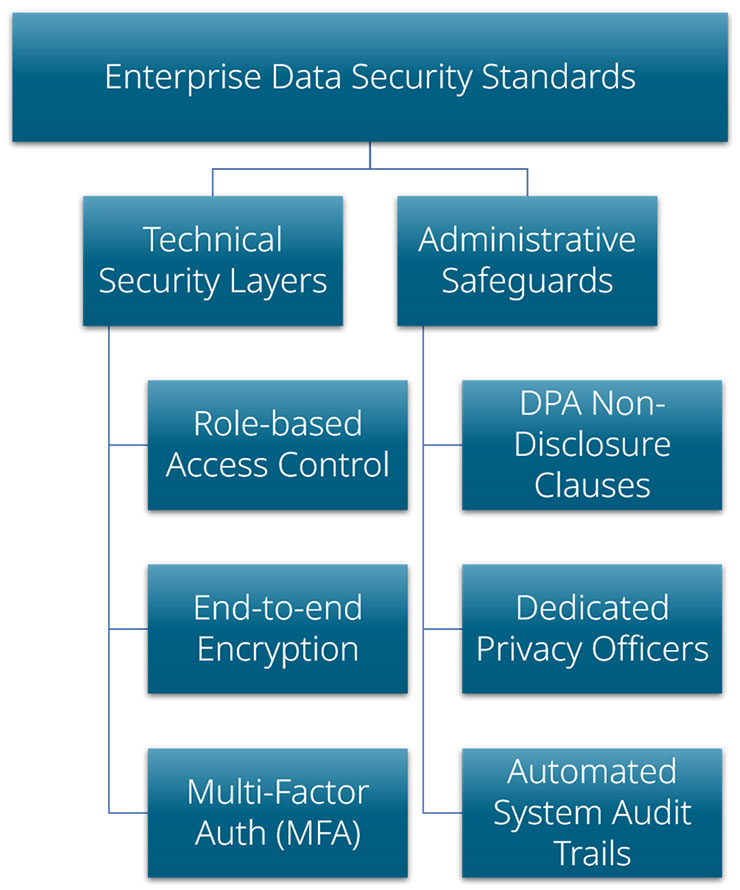
Partnering with an established Philippine payroll BPO provider mitigates this liability. Top-tier providers function as a compliant Personal Information Processor (PIP), securing data with robust protocols:
- Role-Based Access Control (RBAC): Restricting payroll information viewing solely to verified personnel.
- Data Encryption: Keeping records unreadable both while resting on local storage and moving across external networks.
- Comprehensive Audit Trails: Tracking every document adjustment, entry modification, and system export automatically.
The Cooperative Advantage: Exploring the Grupo BPO Model
While traditional business process outsourcing firms focus purely on transactional metrics, Grupo BPO Multipurpose Cooperative operates differently. We are structured as a worker-owned cooperative organization, meaning our payroll managers, HR specialists, and back-office operators are not just employees—they are member-owners with a personal stake in our performance.
This model provides major benefits to our clients:
- Remarkably Lower Attrition: The global outsourcing ecosystem struggles with high turnover rates. Because our member-owners enjoy long-term stability and profit-sharing within our cooperative, we maintain high retention. This gives your business a consistent team that deeply understands your specific account workflows.
- Protection Against Labor-Only Contracting Risks: Working with an asset-heavy, fully capitalized multipurpose cooperative ensures your service contract remains legally distinct from temporary manpower placements. This safeguards your enterprise against employment liabilities.
- Direct Cost Efficiency: As a service-oriented cooperative, our organizational model minimizes administrative overhead, allowing us to pass maximum cost savings directly to your operations.
Future-Proofing Your Business Operations
Running an internal payroll department is no longer an efficient use of company capital. Navigating complex compliance rules, protecting against data breaches, and funding expensive internal software configurations pulls your focus away from core growth priorities.
With Payroll Outsourcing in the Philippines, you insulate your enterprise from regulatory risks, secure sensitive employee data under RA 10173, and instantly lower your administrative costs by up to 70%. Let your executive leadership focus on innovation, sales, and strategy, while our dedicated experts handle the operational engine.
Optimize your administrative workflow today.
Contact the payroll specialists at Grupo BPO Multipurpose Cooperative to request a customized process audit and cost-benefit breakdown tailored to your organization.